
Command, Shift, Overfill: A New Triad in Tech Operations
Drones in Climate Action: A New Frontier for Forest Conservation and Sustainable Agriculture
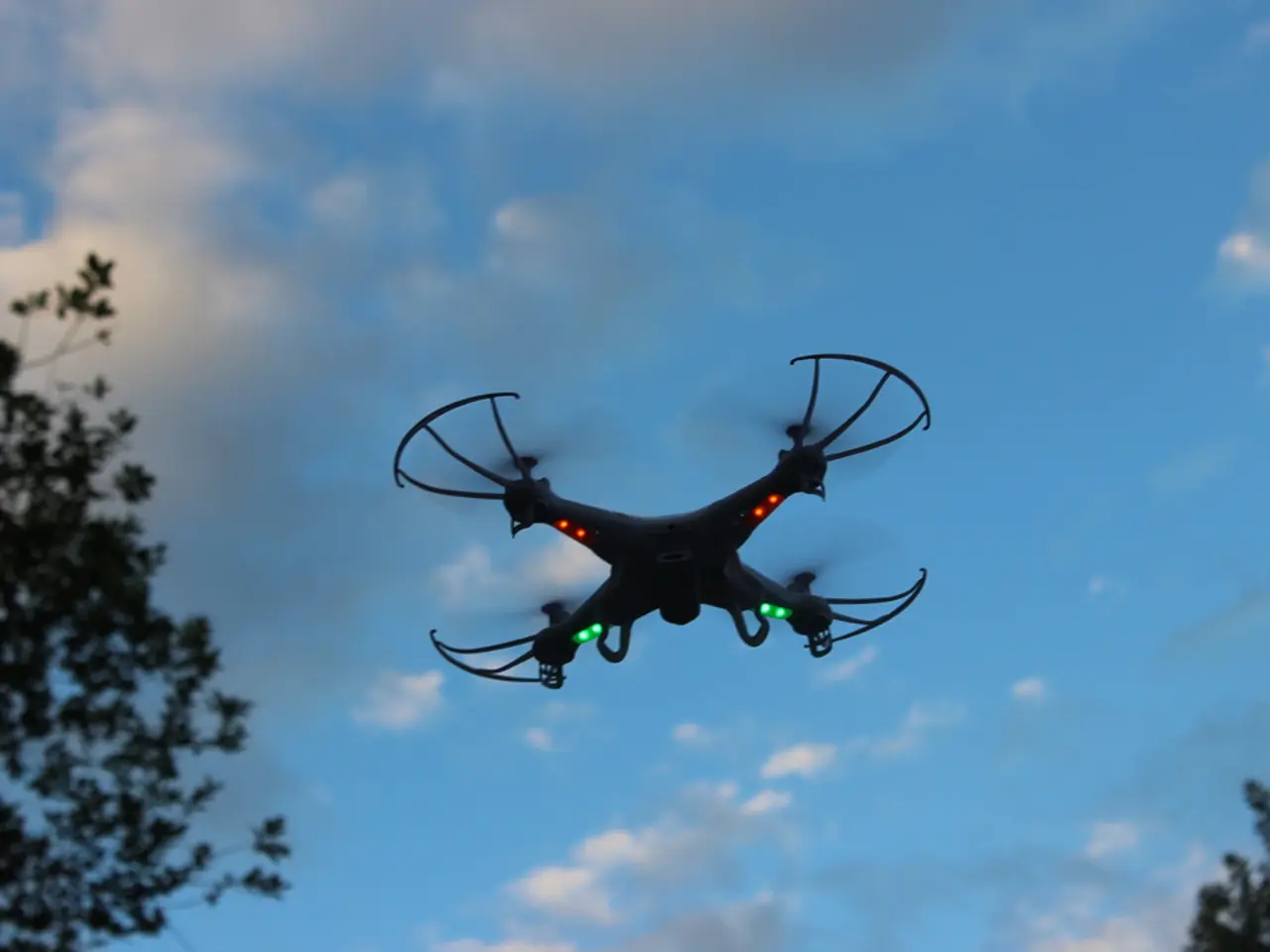
In the fight against deforestation and climate change, drones are proving to be invaluable tools. These unmanned aerial vehicles (UAVs) are used to monitor forests in real-time, detect illegal logging, assess vegetation health, track reforestation efforts, and collect environmental data such as soil moisture and greenhouse gas emissions.
One company at the forefront of this technological revolution is DroneSeed, a Seattle-based startup founded by Grant Canary in 2015. DroneSeed's team consists of experts in military aviation, forestry science, drone hardware, and software programming. The company's drones use an algorithm to recognize ideal "microsites" for planting, which are key to growing tree seeds. They are also used for tree planting and herbicide spraying in the Pacific Northwest, particularly after wildfires.
Meanwhile, in Canada, entomologist Véronique Martel is experimenting with using drones to control the spruce budworm, a forestry pest. Across the Atlantic, Canopée dronautique, a Montreal-based drone company, is testing a corn-plastic-based capsule for protecting Trichogramma wasps until they hatch and crawl out in search of prey. This is part of Canopée's efforts to control the European corn borer, another agricultural pest, in Quebec's organic farm fields.
The use of drones for pest control is not without its challenges, however. Both Martel and Frédéric Jean, one of Canopée's cofounders, commented that some of the biggest obstacles have to do with understanding the biology and timing of the insects, as well as the regulations governing where and when the drones are permitted to fly.
On the other side of the world, Matthew Dunbabin, a robotics professor at Queensland University of Technology, has been designing a sea drone called RangerBot to tackle outbreaks of the coral-eating Crown of Thorns starfish on the Great Barrier Reef. RangerBot can recognize Crown of Thorns starfish with 99.4% accuracy and inject them with a fatal shot of a bile derivative. Between 1985 and 2012, the coral loss on the Great Barrier Reef due to Crown of Thorns starfish outbreaks was responsible for 42% of coral loss.
However, ethical concerns surround the use of these drones. Issues such as privacy, potential misuse of collected data, bias and accuracy in AI algorithms, environmental impact, and the need for responsible regulatory frameworks and community engagement must be carefully considered.
Nevertheless, the potential benefits of drone technology for climate action are undeniable. Drones are assisting in planting trees using seed-dropping technology for rapid reforestation and supporting sustainable agriculture through crop health monitoring and targeted interventions that reduce environmental impact. Drone data is often processed with AI for faster, more accurate analysis and early detection of environmental threats.
As the world's population continues to grow, with the United Nations Food and Agriculture Organization forecasting a growing world population that could hit close to 10 billion by 2050, drone technology could play a crucial role in addressing the challenges of food production and climate change. For instance, Grant Canary, the cofounder of Dropcopter, started the company in response to the pollination gap for farmers due to colony collapse disorder. Dropcopter's "Worker-Bee" drone pollinator has been successful in increasing the proportion of flowers that turn into nuts by 25 to 60% in almond orchards, apples, cherries, and pistachios.
In conclusion, while drones offer powerful tools for climate action through detailed monitoring, restoration, and sustainable land management, their deployment must carefully consider privacy, data ethics, fairness, and ecological impacts to align technological benefits with societal values.
[1] Source [2] Source [3] Source [4] Source
- The magazine article on Climate Action highlights the role of drones in forest conservation and sustainable agriculture, showcasing DroneSeed's initiative in planting trees in the Pacific Northwest.
- Beyond forestry, experts in Canada and Quebec are using drones for environmental science, controlling forestry pests and agricultural pests such as the spruce budworm and European corn borer.
- In the field of art, drone technology is being utilized in unusual ways, like Matthew Dunbabin's design of a sea drone, RangerBot, to deal with the coral-eating Crown of Thorns starfish on the Great Barrier Reef.
- As the world faces the challenge of feeding a growing population, reaching 10 billion by 2050 (United Nations Food and Agriculture Organization), technology like drones could be vital, as demonstrated by Grant Canary's Dropcopter company and the "Worker-Bee" drone pollinator.
- Despite the benefits, it is essential to address ethical concerns regarding drone technology, including privacy, data ethics, fairness, and ecological impacts, to ensure its deployment aligns with general news and societal values.
[1] Source: Drones in Climate Action: A New Frontier for Forest Conservation and Sustainable Agriculture[2] Source: Entomologist Véronique Martel's experiment with drones to control spruce budworm[3] Source: Canopée dronautique's efforts to control European corn borer[4] Source: RangerBot tackling Crown of Thorns starfish outbreaks[5] Source: Grant Canary's Dropcopter company and the "Worker-Bee" drone pollinator




