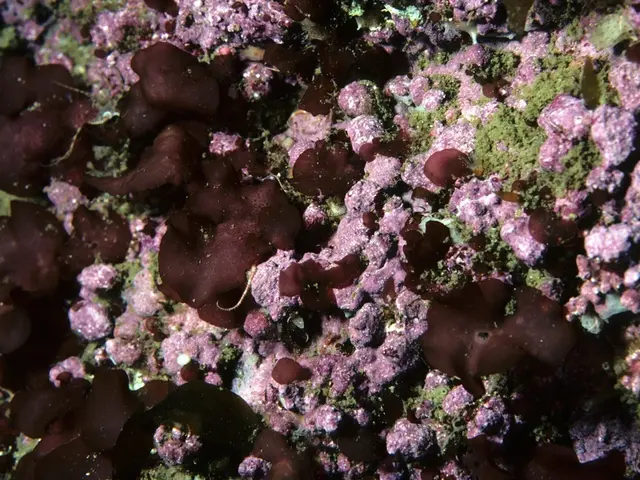
Mars shows peculiar formations resembling coral, sea cabbage, and algae in its landscape.
Since its landing on Mars on February 18, 2021, NASA's Perseverance rover has been exploring the Jezero Crater, a site once believed to have held a lake billions of years ago. On April 4, 2023, the rover captured an image that stirred excitement among scientists and enthusiasts alike – an object resembling a flower or mushroom.
However, after careful analysis, it appears that the intriguing object is not a sign of life but a mineral formation. Similar structures, such as those resembling coral or seaweed, have been encountered by other Mars rovers, including Perseverance and Curiosity. These shapes are typically formed through geological processes on Mars rather than by living organisms.
NASA missions have focused on seeking biosignatures or organic compounds, but have only identified mineralogical evidence indicative of ancient watery environments, not direct fossilized life forms resembling Earth’s coral or seaweed. Abigail Freeman, a researcher on the Curiosity project, suggests these mineral formations were likely formed by sulfates that precipitated out of water that once existed on Mars.
The origin of the object in the image remains mysterious. A hypothesis suggests that it might be a piece that broke off from the rover and got into the frame. However, the object's presence on the rock remains unusual, as it should have been removed by the rover's movement.
NASA's Mars Science Laboratory rover, Curiosity, has been traversing Gale Crater for 13 years, capturing images of various objects in Mars, some resembling plants. Previously, Curiosity sent images of larger, branch-like objects referred to as "seaweed," a lone, standing "mushroom" or "flower," and twig-like structures resembling seaweed with leaf-like appendages at the ends.
Despite the excitement, it's important to remember that these objects, including the "corals," are not alive but are mineral formations. While such structures may signal places where water once existed, they are geological in nature and not confirmed signs of past life.
The Perseverance rover, a robotic geologist and astrobiologist, is currently roaming around the Jezero Crater in search of signs of present or past life. The mission to return samples collected by the Perseverance rover to Earth is scheduled for the middle of the 30s. As of now, NASA has not yet commented on the find.
Despite the lack of confirmation of life on Mars, the intriguing images captured by NASA's rovers continue to fuel the imagination and inspire further exploration. As we continue to unravel the mysteries of the Red Planet, one thing is certain – Mars remains a captivating frontier in our quest to understand the universe.
Read also:
- Giant Luxury Yacht from Lürssen Company Capable of Navigating 1,000 Nautical Miles on Electric Power Solely
- Investment Firm, MPower Ventures, Obtains $2.7 Million in Capital to Broadens Solar Power Offerings Throughout Africa
- Artificial Fuel Explanation: Might Synthetic Fuels Prolong the Lifespan of conventional Internal Combustion Engines?
- Airbus readies for maiden flight test of hydrogen fuel-cell engine of megawatt class