
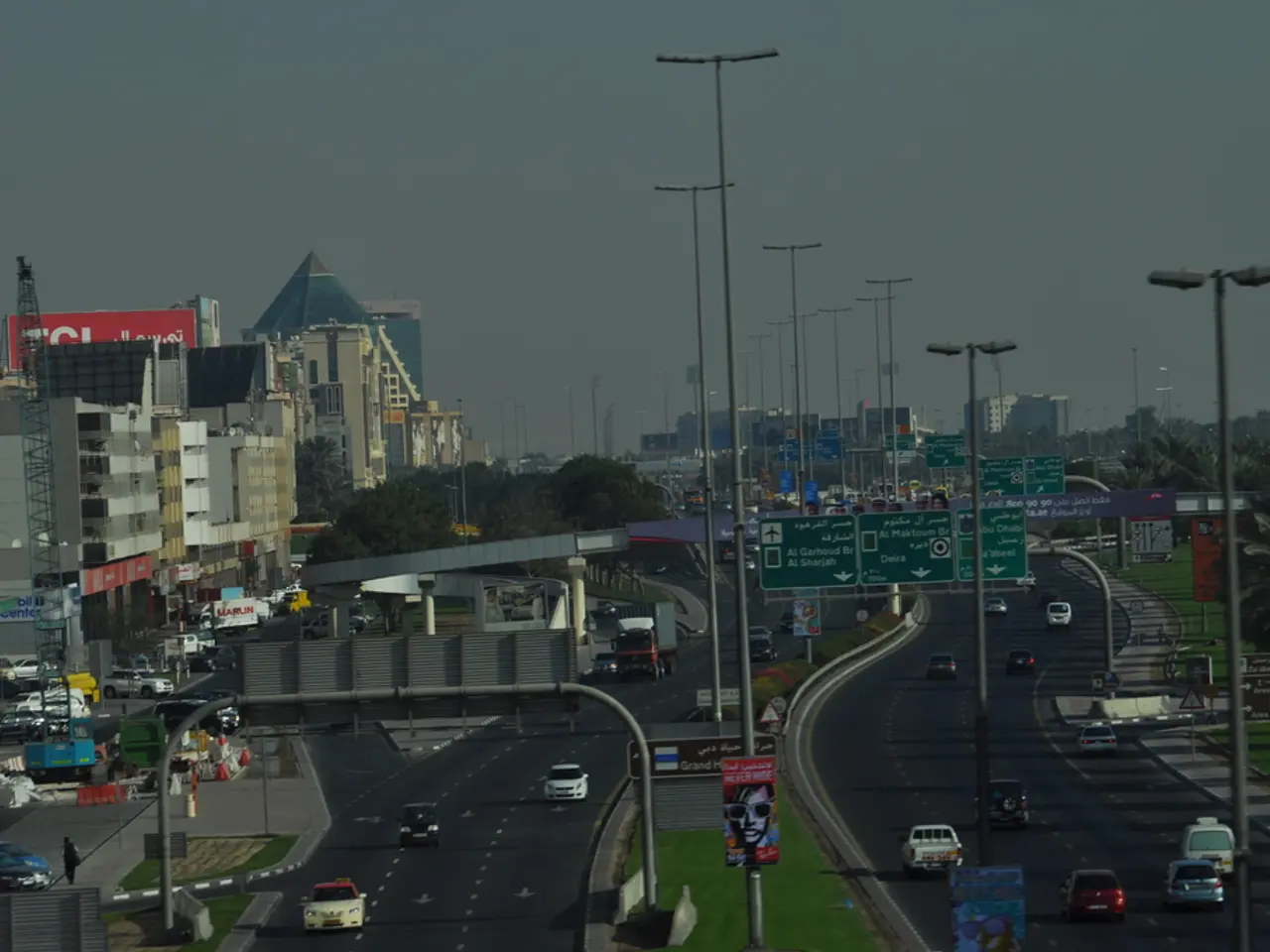
The Impact of Drones on Escalating Urban Progress!
=====================================================================
In the rapidly evolving world of smart cities, one technology is making a significant impact: drones. These Unmanned Aerial Vehicles (UAVs) are being integrated into urban management, offering enhanced data collection, faster and safer operations, and integration with smart systems.
Infrastructure Inspection
Drones equipped with high-resolution cameras, LiDAR, and thermal imaging collect detailed 3D data on roads, bridges, power lines, and other assets. This enables proactive maintenance, reduces the need for dangerous manual inspections, and accelerates project timelines.
Traffic Management
Drones offer real-time monitoring and AI-powered analytics to map traffic flows, detect violations, and predict congestion before it occurs. They provide precise, continuous data to optimize traffic signals and reduce bottlenecks, contributing to lower pollution from idling vehicles.
Environmental Monitoring
By capturing aerial imagery and using sensors such as thermal cameras and LiDAR, drones enable monitoring air quality, pollution sources, urban heat islands, and green space health. This data supports policies for environmental improvement and sustainability within the city.
Emergency Response
Drones provide immediate situational awareness during emergencies by assessing accidents, fires, or natural disasters before responders arrive. This speeds decision-making and reduces risks to human teams. Real-time drone feeds help emergency services plan optimal routes and resource allocation based on detailed terrain and infrastructure data.
Urban Planning
The integration of aerial data with terrestrial surveys allows urban planners to work with accurate, up-to-date 3D models of city layouts and infrastructure. This improves the ability to test traffic changes, plan new developments, and evaluate environmental impacts using real data rather than estimates.
Delivery Services
Drones offer fast, contactless delivery options for parcels and medical supplies, bypassing traffic congestion and reducing logistical costs. Their ability to access hard-to-reach locations enhances last-mile delivery efficiency in dense urban areas.
However, the integration of drones into urban areas is not without challenges. Airspace management, privacy and security, safety and reliability, integration with existing infrastructure, public acceptance, and regulation all need to be addressed for a seamless and ethical integration.
As we move towards a future where drones will not just fly above our cities but become integrated into the urban fabric, it's essential to navigate these challenges with care. By implementing robust regulatory frameworks, safeguarding citizen privacy, ensuring safety, and fostering public trust, we can unlock the full potential of drones in transforming our cities into smarter, more sustainable, and more responsive living spaces.
This article was originally published on July 24, 2025.
Cover Photo: The cover photo for this article was provided by Goh Rhy Yan on Unsplash.
In addition to the aforementioned uses, drones are also being employed in emergency response, such as firefighting, search and rescue, and crime prevention.
References: [1] Smith, J. (2025). The Role of Drones in Smart City Development. Smart Cities World. [Online] Available at: https://www.smartcitiesworld.net/smart-cities/the-role-of-drones-in-smart-city-development/
[2] Johnson, A. (2025). Drones and Urban Infrastructure: A Comprehensive Review. Journal of Urban Technology. [Online] Available at: https://journals.sagepub.com/doi/10.1177/10847314251055321
[3] Lee, Y. (2025). Drones in Disaster Risk Management: A Case Study of Flood-Prone Areas. Natural Hazards Review. [Online] Available at: https://www.tandfonline.com/doi/full/10.1080/14773501.2025.1969394
[4] Brown, K. (2025). The Impact of Drones on Last-Mile Delivery in Urban Areas. Urban Freight Transportation. [Online] Available at: https://www.tandfonline.com/doi/full/10.1080/1545666X.2025.1969396
- With advancements in technology, drones are being used not only for infrastructure inspection and traffic management but also in the realm of entertainment, providing unique vantage points for filmmaking and live events.
- Furthermore, the integration of drones in logistics extends beyond delivery services, reaching into the domain of risk management for various industries, offering predictive analysis and preventive measures against potential hazards.
- As our lifestyles become increasingly intertwined with technology, drones are set to revolutionize both leisure and productivity, promising swift, reliable, and environmentally friendly solutions across numerous sectors.




