
Transforming Agriculture's Carbon Accounting by leveraging Artificial Intelligence for Carbon Cycle Assessment
In a significant step towards a more sustainable future, advancements in Artificial Intelligence (AI) are transforming the landscape of agricultural emissions monitoring. These advancements aim to integrate AI with precision agriculture, the Internet of Things (IoT), and remote sensing, with the ultimate goal of optimizing farm inputs, reducing greenhouse gas emissions, and enabling real-time tracking of environmental impacts.
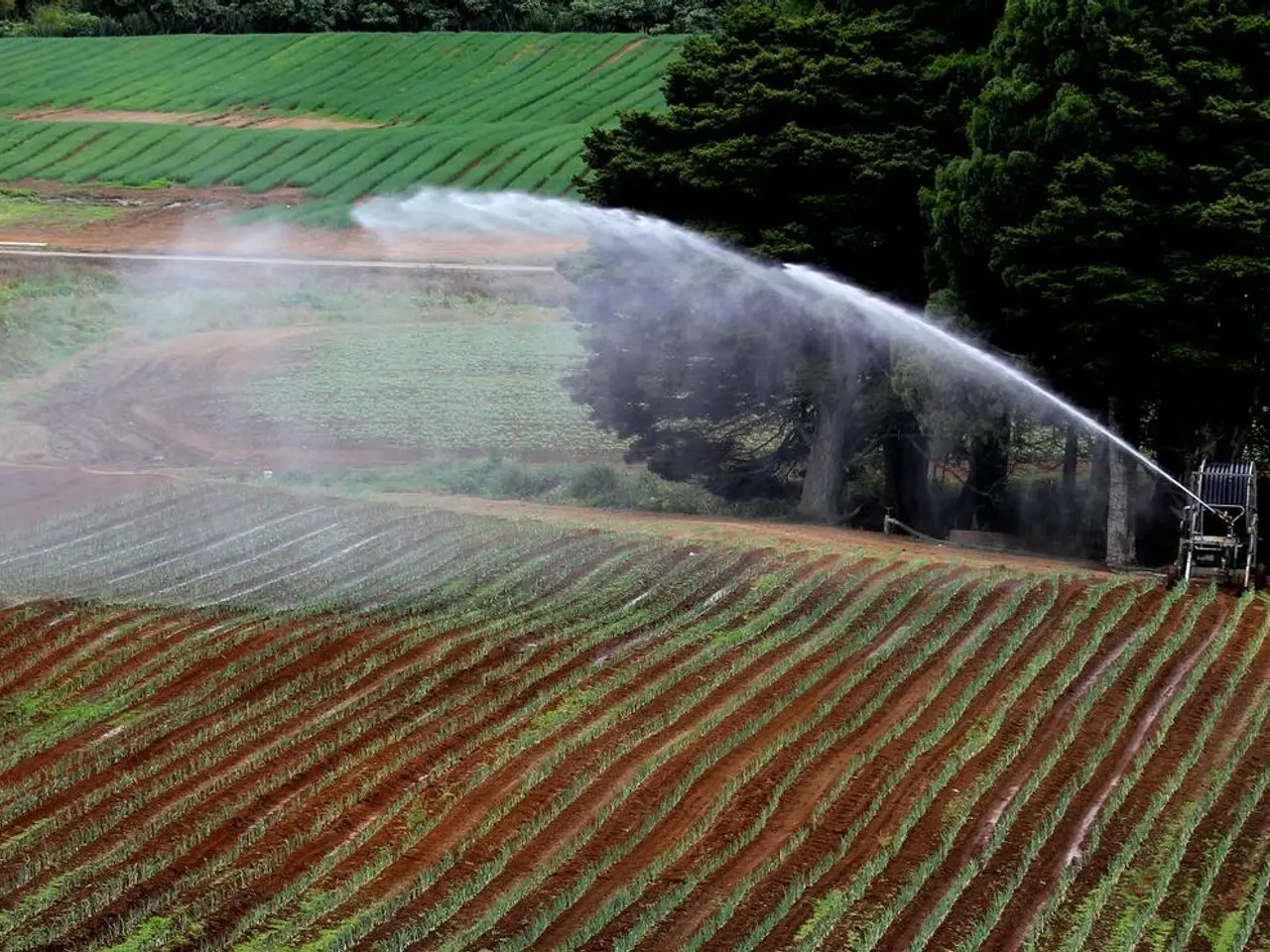
One such promising development is the AI-driven precision agriculture systems, which optimize the use of fertilizers, pesticides, and water based on real-time soil, weather, and crop data. By adopting these systems, farmers can significantly reduce fertilizer use and carbon emissions, aligning agriculture with climate goals. For instance, a study published in Nature Sustainability in 2025 demonstrated AI's role in adapting management to field-specific conditions, resulting in emissions reductions while increasing yields by 15-20%.
The integration of IoT sensors with AI for crop and soil monitoring is another key advancement. This technology enables accurate tracking of emissions-relevant factors such as soil temperature, humidity, nutrients, plant stress, and potential disease or pest outbreaks. Recent improvements include secure, quantum-resistant data transmission, ensuring farmer data privacy.
AI-enhanced remote sensing and deep learning models facilitate precise monitoring of crop growth parameters like Leaf Area Index (LAI), which play a role in estimating carbon flux and biomass. New techniques use synthetic datasets and transfer learning to overcome data scarcity and variability issues, providing robust, low-cost emissions-related crop monitoring across seasons using Unmanned Aerial Vehicles (UAVs) and satellite data.
AI-powered farm Enterprise Resource Planning (ERP) systems extend emissions monitoring by managing operations and inputs smartly—such as timing irrigation or fertilizer application to minimize overuse and emissions—while forecasting financial and environmental impacts across farm activities.
The broader climate data management research underscores the importance of AI integration with climate-resilient infrastructure, edge AI for sensor-based monitoring, and citizen science to enhance local knowledge for emissions tracking and mitigation.
Looking ahead, the deployment of these AI systems at scale, improvements in model explainability and transparency, harnessing edge AI on small, sensor devices for real-time low-latency monitoring, and further integrating AI with regenerative agriculture to build resilient, low-emission farming systems are all areas of future prospects.
The KGML-ag-Carbon model, a new framework that combines AI with agricultural science, is making waves in the field. Based on causal relationships identified within agricultural models, pre-trained on synthetic data, and fine-tuned using real-world observations, this model provides a comprehensive and accessible solution for capturing data on carbon stored in soil. The transformative potential of AI is demonstrated in its ability to combat climate change on a global scale, as shown by the success of KGML-ag in agriculture.
The implications of this innovation extend beyond agricultural emissions monitoring to various sectors, including sustainable forestry management. The KGML-ag-Carbon model's ability to assimilate diverse satellite data types is crucial in forest carbon management. The success of KGML-ag in agriculture fosters trust in carbon markets and supports the wider adoption of sustainable practices.
Transparent and accurate quantification of greenhouse gas emissions is essential for the validation of carbon credits, encouraging more companies to invest in sustainable practices. This technology supports the development of credible and scalable Measurement, Monitoring, Reporting, and Verification (MMRV) systems.
In conclusion, the fusion of precision agriculture, secure IoT, advanced remote sensing, and farm management systems with AI is revolutionizing agricultural emissions monitoring, promising substantial emissions reductions while supporting sustainable and productive farming. These advancements affirm the belief that technology holds the key to preserving our world for future generations.
- The KGML-ag-Carbon model, integrating AI with agricultural science, showcases the potential of technology in combating climate change across sectors, such as sustainable forestry management.
- With AI-powered ERP systems managing farm operations and inputs, farmers can optimize emmission-related decisions, like timing irrigation or fertilizer application, leading to reduced emissions.
- In health-and-wellness and fitness-and-exercise, AI can analyze data from wearable devices to provide personalized fitness recommendations and health assessments, contributing to overall environmental sustainability by promoting a more eco-conscious lifestyle.




